Find Your Fit

Most firms tell you why they’re the right answer. We’ll tell you when we’re not.
Five minutes for senior leaders deciding whether this firm fits theirs. No intake form. No pitch. The first conversation is honest, or it isn’t a conversation worth having.

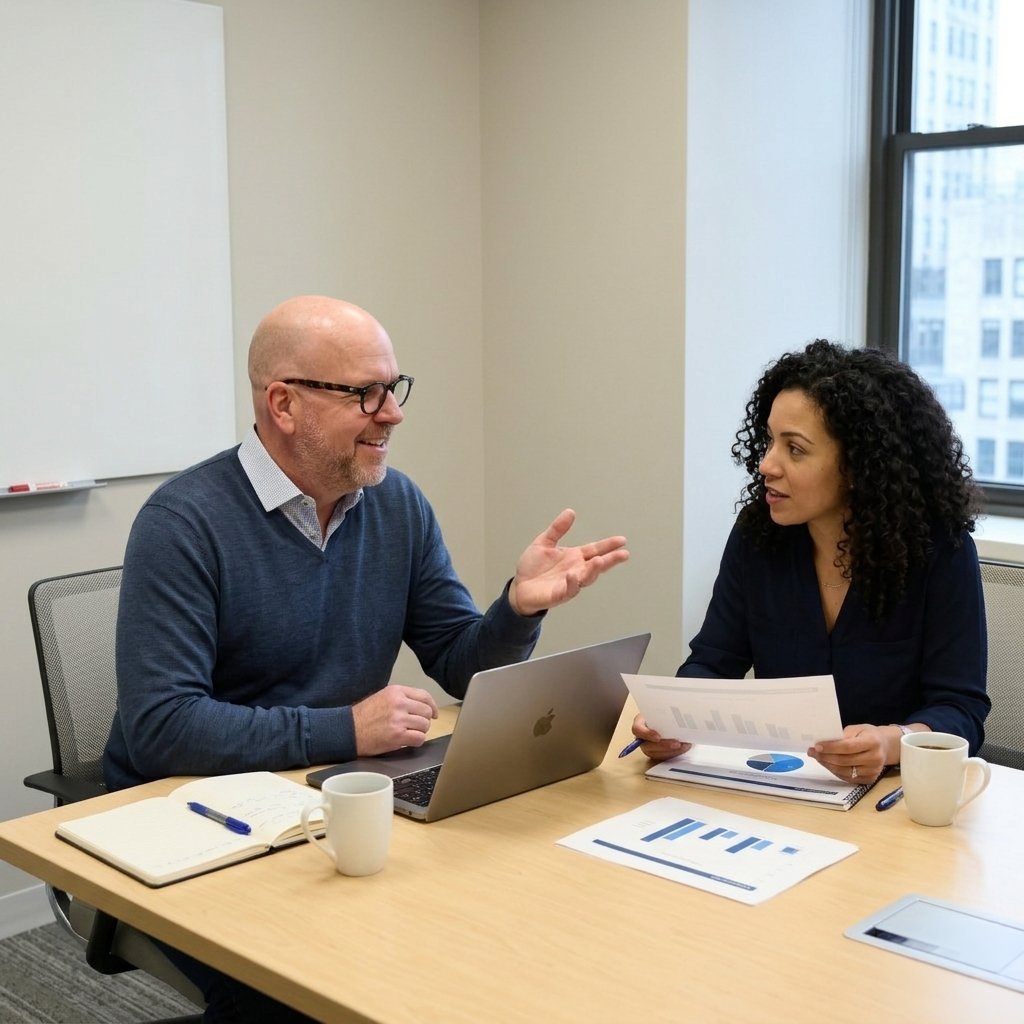
Two leaders mid-conversation in a small office, materials between them
Who This Is For

Three common situations leaders come to us with.

We don’t describe our work by job title or industry. We describe it by the moment you’re in. Below are the three most common situations leaders come to us with — not as personas, but as the actual decisions they’re trying to make.

Situation 01
The Tuesday-morning question
A senior leader carrying a decision they can’t fully discuss inside their own organization — a vendor commitment, a board position, an M&A move, a governance line they’re about to draw. The people who know the most about it are also the people who have something to lose from the answer. They need someone outside the building who can pressure-test it with them at their level, before the meeting on Thursday. Not advice. Not validation. Pressure.
Situation 02
The open line
A senior leader who wants someone they can call, text, or send a quick message to when the hard calls come up — someone who already knows the company, the context, and the people, so there’s no warm-up time when something matters. Available when it matters. Quiet the rest of the time.
Situation 03
“We’ve been talking about this for two years”
A leadership team that knows AI is changing their business model and keeps putting the hard call off. They need structured confrontation, not another inspirational offsite. The kind of session that ends with commitments documented and signed — and an action plan the leadership team can hand down, work against, and measure.
Where You Might Be Standing

Which of these sound like your reality?

Each of these is a real moment a leader has reached out to us about. The engagement that fits each one is named after it — not because the situation determines the answer, but because it points toward the kind of conversation we’d have first.

“There’s a vendor demo on the calendar Thursday. I have a decision in front of me I’m not ready to make — and no one I can think it through with at my level before I do.”
Executive Reframe: One Decision · 90-minute 1:1 working session
or Strategy Sprints · 2–6 week structured engagement
“The board is asking how AI changes our business model — and I don’t have a good answer.”
OBSOLESCENCE Working Session · Three acts, one signed commitment document
“We’ve committed to AI as a strategic priority. We don’t have the decision rights, the guardrails, or the operating model to actually run it.”
“I need a thinking partner I can call when something hard comes up — not a retainer with weekly check-ins I don’t need.”
Strategic Advisory · A standing seat at the table
“We have to move on AI to stay competitive. But the wrong bets at speed cost more than moving slowly — and right now we don’t have an honest picture of where we actually stand.”
AI Maturity Assessment · A grounded baseline before you scale
“The leadership team is moving on AI in five directions at once. We can’t agree on what we’re actually trying to do.”
ALTITUDE Workshop · A framework for leadership clarity
“We have a strategy. We have ten initiatives. We don’t have a plan for which three actually move first — or who owns them.”
IIO Workshop · Ideas to Initiatives to Outcomes
The Honesty Filter

What we don’t do.

A firm that’s honest about its limits is the kind of firm worth hiring. Below is what we don’t take on — not because we couldn’t, but because it’s the wrong fit for the way we work.

What Working With Us Actually Looks Like

Three steps. No surprises.

A decision without a named owner and a written next move is just an opinion. Our job is to turn the decision into the move. Here’s how that happens.

01
First conversation
A discovery call — usually 30 to 60 minutes, conducted privately. We’ll ask what you’re navigating, what kind of counsel you’re missing, and what would be true in twelve months if the relationship worked. No deck, no pre-fill form, no follow-up sales sequence. If it’s not a fit, we’ll tell you in the call.
02
The Frame
Within 48 hours of a fit conversation, we send a one-page written description of the engagement — fixed fee, timeline, what we’ll do, what you’ll have at the end, and what we need from you. No surprises later. No scope creep dressed up as “next phase.”
03
Delivery
Every engagement produces one written outcome, one named owner, and one committed move. Six to twelve pages of written work that names what gets done, who does it, and by when. That’s the artifact. That’s the point.
The Reverse Filter

What we look for in the leaders we work with.

Most consulting pages talk about what you should expect from the firm. This is the inverse — what we need from you for the work to land. We’re selective about who we work with for the same reason you should be selective about who you hire. The work is too important for either of us to fake it.

Explicit Anti-Fit

When we’re genuinely the wrong call.

Some moments need a different kind of firm. Naming them honestly is part of what makes the right matches work.

If any of this sounded like your room, that’s enough to start a conversation.

Start a Conversation

The right engagement begins with the right conversation.

Signal & Horizon takes on a small number of clients at any given time — by design.

No sales funnel. No pitch deck. Tell us what you're navigating and we'll tell you honestly whether and how we can help.

No sales funnel. No automated follow-up sequence. A real conversation.