An Operator-Led Practice

Strategy
to Motion

The decisive work between intent and execution. For organizations that have plenty of strategy but can’t translate it into the specific decisions and moves that make it real. Operator-led engagements that produce practical outcomes your team can act on.

Posture
Operator-led
Scope
Set in discovery
Output
One named owner
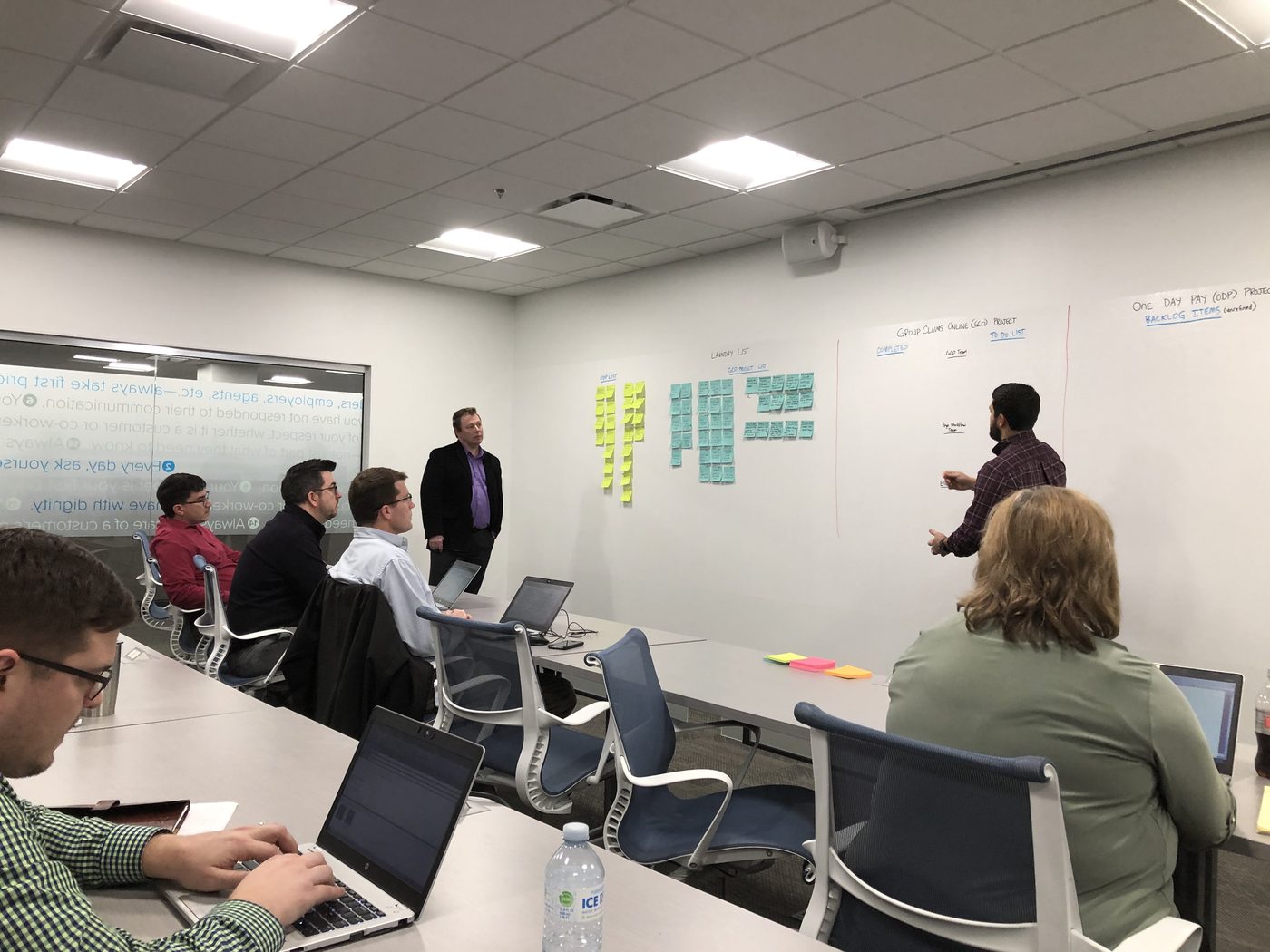
Signal & Horizon operators working through implementation planning with a client team — laptops, whiteboard backlog, real strategic work in progress
The Premise

Strategy is decided more often than it’s executed.

Most enterprises don’t suffer from a shortage of strategy. They suffer from a shortage of the specific, operator-led work that turns a strategic decision into a Monday morning that looks different from the Friday before. The board sees the deck. The leadership team agrees on direction. And then the operating model, the workflows, the data, the governance, the org math — all of it has to actually change. That’s where most strategies die.

Strategy to Motion is the practice that does that work. Not as a fixed-scope productized service, and not as a system integration handoff. As a series of operator-led engagements that translate one strategic question at a time into one specific, executable answer your team can act on — with one person named to own it.

The Operating Principle
A decision without a named owner and a written next move is just an opinion. Our job is to turn the decision into the move.
The premise behind every Strategy to Motion engagement.
What Clients Actually Ask

The questions Strategy-to-Motion engagements typically start with.

No two engagements are the same because no two strategic questions are the same. The list below is illustrative — real questions clients have brought us, in something close to the words they used. Some became single engagements. Some became three. Some led to us recommending a different firm entirely. The right answer is always set in discovery.

Question 01
“We picked the platform. Now what does the operating model actually look like?”
A common pattern: the technology decision is made, but the org math hasn’t caught up. Who owns the platform. How requests come in. What governance looks like in practice. Where the operating model needs to bend, and where it needs to hold.
Question 02
“Our pilot worked. Why isn’t it scaling?”
The pilot succeeded in controlled conditions. Production reality breaks it. Usually the data isn’t actually ready, the workflow assumptions don’t hold at scale, or the governance posture needed for one team won’t survive ten. The question isn’t whether to scale — it’s what to fix first.
Question 03
“Should we build this, buy it, or assemble it from what already exists?”
The default answer is “buy.” The right answer is rarely the default. Build-buy-assemble is a question about your operating posture, your existing capability, your real cost of integration, and your tolerance for vendor lock-in. We help leaders make that call honestly.
Question 04
“The strategy is set. What do we tell the middle of the organization on Monday?”
Executive alignment doesn’t produce execution. The translation layer — what changes for whom, what the new operating model means at the director level, what the first 90 days actually look like — is the work that gets skipped because it’s tedious. It’s also the work that determines whether strategy becomes reality.
Question 05
“Our data’s a mess. Is it ready enough to start?”
Most enterprise data isn’t ready. Some of it doesn’t need to be. The question is which decisions and which workflows require which data quality threshold — and which ones can move forward while the data work runs in parallel. A clear-eyed read on data readiness is rarer than it should be.
Question 06
“We’re in a regulated industry. How do we move fast without breaking governance?”
In regulated environments, governance isn’t a checkbox — it’s the work. Banking, insurance, healthcare, public sector. The right operating model treats compliance and risk as constraints that enable speed when designed well, not constraints that prevent it. We’ve done this work in all of those environments.

These are starting points, not service codes. The actual engagement is named, scoped, and committed to in writing after discovery.

The Work That Emerges

Seven engagements. Each scoped to one question. Each owned by name.

The work below is the kind of engagement Strategy-to-Motion clients typically end up commissioning, after discovery. They’re named, scoped, and priced individually — not bundled, not sold as a package, and not picked off this page. We name them here so you can recognize the kind of work this practice does, not so you can shop it. Most engagements include one or two of these. A few include three. Almost none include all seven.

How An Engagement Gets Scoped

Discovery, scoping, delivery. In that order. Never reversed.

Strategy to Motion engagements are never sold from a fixed-scope statement of work written before we’ve met. The work is too sensitive to the specifics of your business, your strategy, and your team for that. Every engagement follows the same three acts, in the same order.

Act I  ·  Discovery
Listen
A short, focused conversation — usually 30 to 60 minutes — to understand the strategic question you’re actually trying to answer, what’s already been tried, and what would be true in six months if the engagement worked. No deck, no scoping document, no invoice. Just the conversation that determines whether and how we can help.
Act II  ·  Scoping
Name the Work
A written one-page engagement description: the question being answered, the work that will be done, the outcome that will be produced, the owner who will be named, the duration, and the price. Sent within 48 hours of the first conversation. You decide whether to proceed. Most clients say yes. Some don’t. Both answers are honest.
Act III  ·  Delivery
Do the Work
The engagement itself. Operator-led, conducted with your team where the work actually happens — not in a conference room with a vendor pitch. Output is one written outcome with one named owner, delivered on the timeline named in scoping. If a follow-up engagement makes sense, it’s discussed openly. If not, the engagement ends clean.
Positioning

Strategy to Motion is often mistaken for adjacent work. It’s a different practice.

There are many firms doing work in the same neighborhood: strategy consulting, implementation services, system integration, “AI transformation” consulting, IT advisory. Each has its place. None of them are designed for the specific seam Strategy to Motion is built for — the operator-led translation between a decision being made and the decision being executed.

This isn’t

  • Strategy consulting (we don’t produce strategies; we translate them)
  • Implementation services or staff augmentation
  • System integration or platform deployment
  • “AI transformation” framed as a single multi-year program
  • Fixed-scope, pre-priced productized engagements
  • A vendor-aligned advisory practice with platform incentives
  • A pre-built methodology applied identically to every client

This is

  • The operator-led work between strategy decided and strategy executed
  • Engagements scoped from discovery, named in writing, owned by name
  • Tool-neutral analysis with no platform or vendor incentives
  • Practical work delivered with your team, in your environment
  • Designed for regulated, complex, and enterprise-scale realities
  • One question, one written outcome, one named owner — per engagement
  • Sometimes a single engagement. Sometimes a sequence. Never a package.
What You Walk Out With

Three things. Per engagement. Written, owned, executable.

Every Strategy-to-Motion engagement ends with the same three things, regardless of which of the seven shapes the work takes. The output is designed to be acted on, not filed.

01
One Written Outcome
A short, decisive document — usually 6 to 12 pages — that answers the question the engagement was scoped to answer. Written for senior leaders, not for the file. Designed to be re-read in six months and still be useful.
02
One Named Owner
A specific person on your team named as the owner of what the engagement produced. Not a committee, not an organization, not a function. One person who will carry the work forward — identified together, in writing, before the engagement ends.
03
One Committed Move
The specific decision or action the team has committed to, dated and visible. Not a roadmap. Not a deck of options. One thing that changes on Monday as a result of the work, with the person who’ll own that change named alongside it.
Start An Engagement

Bring us the question. We’ll tell you honestly what the work looks like.

Strategy to Motion engagements start with a 30-to-60-minute discovery conversation — no deck, no scoping document, no preliminary invoice. The first call tells us both whether and how we can help. The follow-up tells us, in writing, what the engagement should look like.

If the answer is no — if the question you’re carrying is better served by a different engagement, a different firm, or a different month — we’ll tell you that honestly. Most discovery conversations end with one of three outcomes: a written engagement scope, a recommended referral, or a clear “come back in six months.” All three are honest.

Start a Conversation

The right engagement begins with the right conversation.

Signal & Horizon takes on a small number of clients at any given time — by design.

No sales funnel. No pitch deck. Tell us what you're navigating and we'll tell you honestly whether and how we can help.

[email protected]

No sales funnel. No automated follow-up sequence. A real conversation.