A 2026 Limited Engagement

OBSOLESCENCE

Obsolescence is a choice. Make it consciously.

A working session for senior leaders who'd rather confront what AI is making obsolete in a room with their own team — than find out from a competitor, a board member, or a customer who already has.

Format
Half-day to multi-session
Audience
C-suite to full organization
Availability
2026 — limited
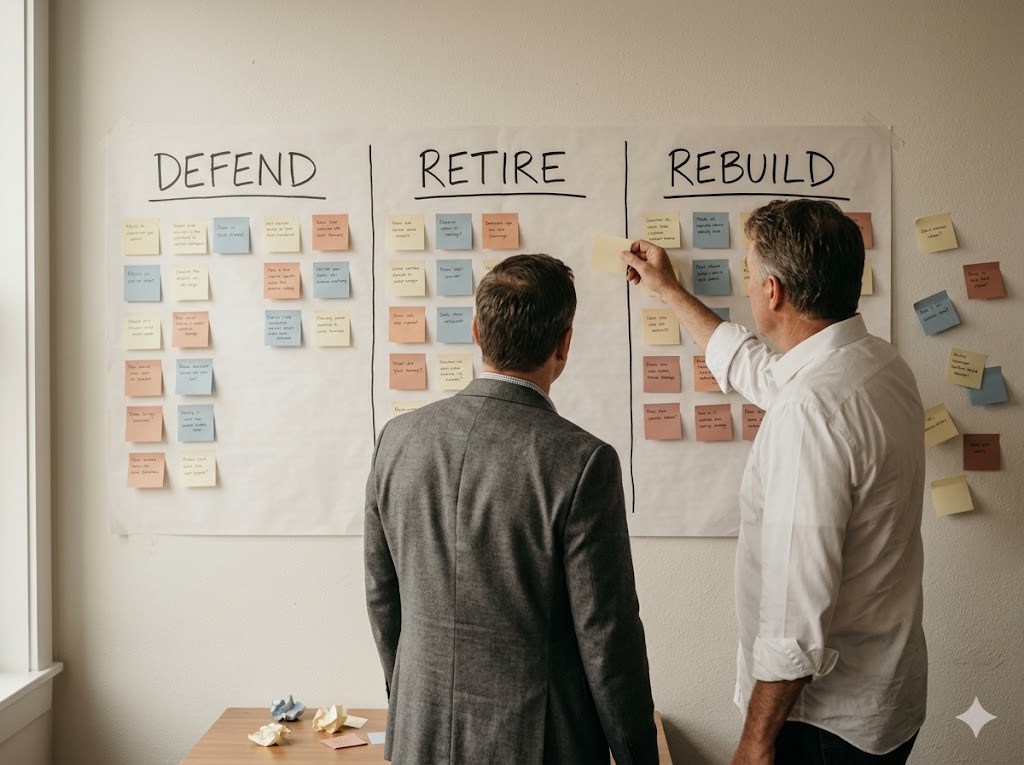
Two senior leaders evaluating Defend, Retire, and Rebuild columns on a working wall during an OBSOLESCENCE session
The positioning

This is not just another AI workshop.

Most leaders are treating AI as an upgrade. It isn't. It's a reset of what the business sells, how it delivers, and who does the work. The leaders who recognize this are making deliberate decisions about what to defend, what to retire, and what to rebuild. The leaders who don't are making those same decisions by default — they just aren't the ones making them.

OBSOLESCENCE is a working session for senior leaders who would rather confront that honestly, in a room, with their own team, than find out from a competitor, a board member, or a customer who already has.

The thesis
Obsolescence isn't an accident. It's a decision leaders defer until someone else makes it for them.
The operating principle behind OBSOLESCENCE.

This is a leadership workshop about what AI is forcing leaders to decide. The frameworks are tool-neutral. The facilitation is operator-led. The conversation is the one most leadership teams have been avoiding.

The framework

Three Acts. Three Decisions. One Commitment Document.

OBSOLESCENCE runs a deliberate arc. Each act has a purpose. Each act ends with something written down. The structure is consistent across every tier — what changes is intensity, not sequence.

Act I
Confront
What's actually at risk, and why most leadership teams can't see it clearly. The first act isn't about AI. It's about the quiet assumptions the business was built on — and which ones AI has already broken.
Surface the model underneath
Articulate what the business actually sells, not what it says it sells. Name what customers actually pay for.
Name the assumptions
The five to seven load-bearing beliefs the current model depends on. Most leadership teams have never spoken them out loud.
Stress-test against AI
Which assumptions already don't hold. Which are wobbling. Which are still intact. An honest inventory, not a threat assessment.
Act II
Choose
What to defend, what to retire, what to rebuild. The middle act is where most workshops fail — they surface risk and pivot to generic frameworks. This one forces the team to make actual choices about their own business. Live. In the room.
Defend
What's genuinely differentiated and worth protecting — and what investment that protection actually requires.
Retire
What the business should stop selling, stop doing, or stop charging for — even if it's currently profitable.
Rebuild
What needs to exist that doesn't yet. What the rebuilt version looks like when AI is assumed rather than bolted on.
Act III
Commit
What changes Monday. The final act is the one most workshops skip. It converts the conversation into commitment — not a 90-day plan, not a roadmap. A small set of decisions leaders are willing to own by name, with timing, and with the authority to execute.
One thing retired
A service, a pricing structure, a process, a headcount assumption. Named. Stopped within 90 days.
One thing rebuilt
A workstream, a team, a product line. Named owner. Budget decision. First milestone on the calendar.
One thing confronted again
The assumption the team couldn't resolve in the room. A date to revisit it. The people who need to be there.
Honest inventorywhat's at risk
Defend / Retire / Rebuildlive decisions
Signed commitmentswhat changes Monday
The lenses

Eight Domains. Three or Four per Engagement.

These are not session topics. They're the lenses the workshop uses to examine the business. No engagement touches all eight — the facilitator selects the three or four most relevant to the client's actual situation, identified in a pre-engagement working session with the sponsor.

Lens 01
The Value Migration
What customers actually pay for now — and where that's shifting. Most businesses still price the old value, not the new one.
Lens 02
Pricing at Zero Marginal Cost
What holds when delivery is nearly free. Which pricing logic survives when the underlying cost curve collapses.
Lens 03
The Model Underneath
What the business is really selling — not what the deck says. The honest answer is often different from the marketed one.
Lens 04
Scaling Output, Not Headcount
The new org math. What changes when capacity decouples from staffing, and what the headcount-based planning model gets wrong.
Lens 05
Work, Rebuilt
What end-to-end looks like without legacy scaffolding. Most processes still assume human hands at every step.
Lens 06
The New Division of Labor
Who decides, who executes, who reviews. The agentic stack is forcing a re-architecture of roles most orgs haven't named yet.
Lens 07
Where Judgment Lives
Risk, ownership, and accountability in an agentic stack. In regulated industries this lens isn't theoretical — it's the whole conversation.
Lens 08
Running an Agentic Business
Operating when agents are inside the workflow. What the org chart, the PnL, and the operating model look like on the other side.

Each lens is applied to the client's actual business, not presented as content. The frameworks are in service of the client's decisions, not the other way around.

Positioning

What OBSOLESCENCE Is — and What It Isn't

This work is often mistaken for an AI briefing, a strategy offsite, or a leadership development event. It's none of those things. The distinction matters because it shapes who should be in the room — and what they should expect when they get there.

This is not
An AI briefing or tech overview
A vendor pitch or platform recommendation
A facilitated brainstorm about "the future"
A session that ends with an inspirational slide deck
A place to defer hard decisions to Q3
This is
A working session about your specific business model
Tool-neutral, vendor-neutral, governance-fluent
Structured confrontation of deferred decisions
A session that ends with a signed commitment document
Designed to leave leaders clearer, not comfortable
Delivery

Three Tiers. Same Three-Act Spine.

OBSOLESCENCE scales to the audience without losing its structure. Executive teams get depth and confidentiality. Leadership groups get working time and structured disagreement. Organizations get cascade and shared language. The framework is consistent; the intensity is not.

Tier I
Executive Session
Half-day · 6–12 leaders
Confidential, off-the-record. Designed around the client's actual business model, not a generic framework. Facilitator works with the CEO or sponsor in advance to identify the two or three domains most relevant to the business right now. Three hours of structured confrontation, choice, and commitment. No slides. No deck-back.
Best for
Executive teams aligning on a strategic direction before cascading it. Teams facing a specific inflection — pricing pressure, new entrant, board question, M&A consideration.
Output
A one-page executive commitment document. Confidential. Signed, dated, owned.
Tier II
Leadership Team Intensive
One to two days · 15–40 leaders
The fuller version. Day one runs Confront and Choose. Day two runs Commit and sequences the commitments into a decision calendar. More domains covered. More working sessions. More structured disagreement. Includes pre-work: each participant writes a one-page "what I think is at risk" memo before arriving.
Best for
Senior leadership groups moving from private conversation to team commitment. Companies in active transformation or annual planning cycles.
Output
Defend / Retire / Rebuild map by function or business unit. Commitment document with named owners. A 90-day decision calendar.
Tier III
Organizational Rollout
Multi-session · 100+ participants
For companies where the executive team has already made the call and now needs the wider organization aligned. Runs as a sequenced program: a leadership keynote that names the obsolescence question, followed by function-level breakouts using the same three-act spine, then a synthesis session that rolls findings back up to the executive team.
Best for
Mid-to-large enterprises mid-transformation where the top team is aligned but the middle layer is unclear on what's changing and why.
Output
Function-level obsolescence maps. A shared language across the organization. Prioritized cross-functional commitments owned at VP level.

Every tier shares the Confront / Choose / Commit spine. What scales is intensity, audience, and artifact depth — not structure.

The Signal & Horizon difference

What Makes This Different From Every Other AI Workshop

There's no shortage of events and sessions promising to help leaders navigate AI. Most are built around inspiration, vendor content, or generic frameworks applied to hypothetical companies. OBSOLESCENCE is built around the opposite.

Perspective-driven, not prescriptive
The workshop doesn't tell leaders what to do. It structures the conversation they've been avoiding and forces them to decide in the open.
Tool-neutral
No vendor pitches. No model recommendations. No "here's how to deploy agents." The session is agnostic about which AI, which platform, which stack.
Operator-led
The facilitator has run enterprise transformations, not analyzed them. That shows up in how the session handles pushback and the moments when a leader says "we can't actually do that."
Governance-fluent
For regulated industries, the Where Judgment Lives lens isn't theoretical. The workshop handles risk ownership, audit trails, and accountability in ways a generic innovation shop can't.
Deliberately uncomfortable
Most workshops are designed to leave leaders feeling good. OBSOLESCENCE is designed to leave them clearer — which sometimes means leaving them unsettled. That's the product.
Ends with a commitment
Every tier ends with a written, owned, dated artifact. No vague follow-ups. No "we should circle back." A document the team has signed and the CEO has seen.
What leaders take away

The Artifact Is the Point.

Most leaders leave offsites energized. Leaders leave OBSOLESCENCE with three things written down that they're accountable for. The session produces something — not just a feeling of progress, but a document the team has seen, signed, and agreed to.

A clear-eyed map of what's at risk
Not a threat assessment. An honest inventory of which business-model assumptions are still holding, which are wobbling, and which have already broken.
A Defend / Retire / Rebuild map
What's worth protecting. What's worth stopping, even if profitable. What needs to exist that doesn't yet. Named owners. Honest disagreement on the table.
A signed commitment document
One thing retired. One thing rebuilt. One thing confronted again. Dated, owned, circulated to the team. The artifact the CEO can point to six months from now.
A different language for the conversation
Teams leave with shared vocabulary — the lenses, the three acts, the Defend / Retire / Rebuild frame. The next strategy meeting moves faster because the team is no longer defining terms.
Book a 2026 Engagement

Most leaders defer this conversation. The ones who don't are building the businesses the rest will compete against.

Signal & Horizon is accepting a small number of OBSOLESCENCE engagements for 2026 — by design.

If you are navigating a business-model question that AI has already started to answer for you — or a leadership team still treating AI as an upgrade rather than a reset — the conversation starts here. Brief, honest, no sales funnel. We'll tell you in the first exchange whether this is the right fit.

No sales funnel. No automated follow-up. A real conversation.