A Private Working Session

Executive Reframe
One Decision

A 1:1 working session for a senior leader carrying a decision that hasn’t resolved. Ninety minutes — in person or remote. One reframed question. One committed move. One written artifact. Confidential by default.

Format
90 minutes, 1:1
Audience
A single executive
Output
One written artifact
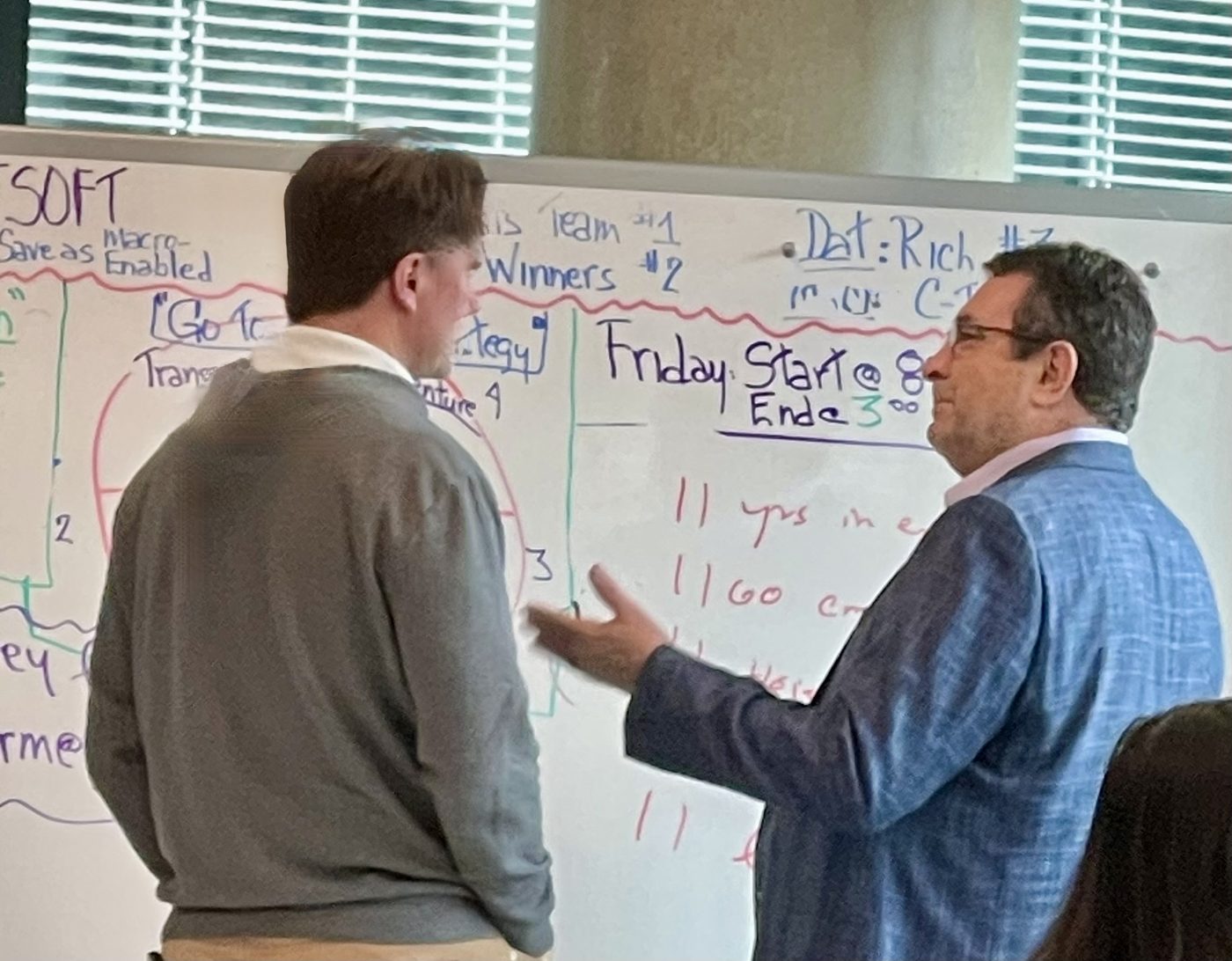
A senior operator working through a strategic decision at a whiteboard with an executive
The Premise

Some decisions don’t need more analysis. They need a different altitude.

There’s a kind of decision senior leaders carry that doesn’t respond to more data, more discussion, or more time. It sits with you. It surfaces in three meetings about something else. It changes shape depending on which advisor you’re talking to. And it doesn’t resolve.

Usually, the problem isn’t that you lack information. It’s that you’re looking at the question from the altitude you’ve always looked at it from — and the right answer becomes visible from a different one. Executive Reframe is the ninety minutes it takes to find that altitude, with an operator who’s already made decisions of similar weight.

The Operating Principle
The quality of your decision is determined before you make it — by where you’re standing when you look at the problem.
The premise behind every Executive Reframe.
How It Works

Three acts. Ninety minutes. One decision examined honestly.

Every Executive Reframe follows the same arc, regardless of the decision in front of you. The structure is consistent because what shifts isn’t the framework — it’s the altitude you’re looking from. The work happens in the room, in real time, with nothing prepared in advance and nothing filed afterward.

Act I  ·  First 20 minutes
Surface
You describe the decision in your words. The operator listens, asks two or three questions, and surfaces the assumptions running underneath. Most decisions look different once their load-bearing assumptions are spoken out loud.
Act II  ·  Next 50 minutes
Reframe
The real work. The decision gets examined from altitudes you haven’t tried — the operator’s prior experience, the dimensions you’ve been avoiding, the question you’re actually being asked rather than the one you’ve been answering. By the end, the question itself has usually shifted.
Act III  ·  Final 20 minutes
Commit
The session ends with one thing written down: the reframed question, and the single move you’re willing to make as a result. Not a plan. Not a deck. One sentence and one commitment. Sent to you within twenty-four hours.
What You Walk Out With

Three things. In writing. Within twenty-four hours.

Most executive conversations end in promises to follow up. This one ends with an artifact. The work in the room produces three concrete things — each captured in writing and sent to you afterward, regardless of where the conversation ultimately landed.

01
One Reframed Question
The question you walked in with, rewritten as the question you’re actually trying to answer. Sometimes a small revision. Sometimes a completely different question. Either way, the one you’ll actually decide against.
02
One Committed Move
Not a plan, not a roadmap, not a strategy. A single, specific thing you’re willing to do as a result of the conversation. Named, dated, and yours to own. If the session didn’t produce one, that’s also written down honestly.
03
One Written Artifact
A short, confidential summary you can re-read in six weeks, share with the one person who needs to see it, or keep for yourself. Written in your voice, not in consultant prose. Designed to be useful, not impressive.
Audience

Who this is for — and who it isn’t.

This is for you if
  • You’re carrying a decision that hasn’t resolved — and you’ve already had the obvious conversations with the obvious people.
  • You need a real working session, not a coaching engagement or a series of weekly calls.
  • You want to think out loud with an operator who’s made decisions of similar weight — without it becoming a project.
  • Confidentiality matters. You’d rather not raise this with your team yet. You may not raise it at all.
This isn’t for you if
  • You’re looking for executive coaching, leadership development, or a long-term mentorship arrangement.
  • You need a strategy deliverable for your team, board, or investors — this produces one written artifact for you, not a deck.
  • You want the conversation to validate a decision you’ve already made. The session is designed to interrogate, not to confirm.
  • You’re looking for a sales conversation about a larger engagement. This is its own thing — sometimes a sequence follows, often it doesn’t.
Positioning

Executive Reframe is often mistaken for other things. It’s none of them.

Senior leaders have access to plenty of advisors. Coaches, strategy firms, board members, peer groups, fractional executives. Each serves a purpose. None of them are designed for the specific moment Executive Reframe is built for — the ninety minutes that turn an unresolved decision into a written commitment.

This isn’t

  • Executive coaching or leadership development
  • A therapy session or a place to process feelings
  • A strategy consulting engagement or a workshop
  • A sales conversation about a larger project
  • A board readout, deck review, or talking-points session
  • A retainer-style ongoing advisory relationship
  • A networking call or a thought-leadership exchange

This is

  • A private working session, scoped to ninety minutes
  • One executive, one operator, one decision examined honestly
  • A reframed question and a committed move, in writing
  • Confidential by default — the conversation stays in the room
  • Designed for the question your team can’t help you answer
  • A standalone engagement — no follow-up unless you ask for it
  • Honest pushback delivered by someone who’s already made the call
How To Engage

Three ways the session happens. Same structure. Same outcome.

The work is identical regardless of format. What changes is the logistics — how the conversation reaches you, where it happens, and how quickly we can have it. Most Executive Reframes happen within the same week the request comes in.

Format 01
In Person
Your office, a private meeting space, or a neutral location of your choosing. 90 minutes plus travel coordination. The full session, conducted in the room with no recording and no notes shared outside it.
Format 02
Remote
A private video session conducted from wherever you are. Most Executive Reframes happen this way. Same structure, same artifact, often available within the week. Recording is offered but never default.
Format 03
Walking Session
For leaders who think better moving. Conducted by phone, while you walk. Ninety minutes, the same arc, the same written artifact afterward. Designed for the conversation that needs to happen but doesn’t need a conference room.

Confidentiality is the default in every format. Nothing is recorded without your consent. The written artifact is sent to you and to no one else. The session itself is not referenced in any Signal & Horizon materials, including case studies, without your explicit permission.

Book A Session

If you’re carrying a decision that won’t resolve, the conversation starts here.

There’s no intake form, no scoping call, and no pitch deck. A brief exchange to understand what you’re navigating, a confirmation that we’re the right fit for the question, and the session goes on the calendar. Most often, within the same week.

Reach out below. If the answer is no — if the decision you’re facing is better served by a different engagement or a different firm — we’ll tell you that honestly in the first exchange.

Start a Conversation

The right engagement begins with the right conversation.

Signal & Horizon takes on a small number of clients at any given time — by design.

No sales funnel. No pitch deck. Tell us what you're navigating and we'll tell you honestly whether and how we can help.

[email protected]

No sales funnel. No automated follow-up sequence. A real conversation.